
https://bruno-berger-project.prev00.rmkr.net

Rainmaker Platform

  • Home
  • About Us
  • Contact Us
  • Block Examples
  • Landing Page
  • Pricing Page
You are here: Home / Archives for Uncategorized

The Relevance Maturity Matrix Helps B2B Marketers Close the Gap

posted on January 20, 2026

A good customer experience must be relevant. According to Forrester Principal Analyst Mary Shea, “Your buyers want contextual interactions with both human and digital assets across a holistic, but non-linear journey.”

As I stated in my book, Digital Relevance, “…a process for continuous improvement will enable your marketing team to tweak and refine strategy progressively to keep your brand relevant in the face of change.”

Unfortunately, the following recent research findings indicate not a lot has changed since I wrote my book four years ago:

  • 55% of B2B marketers somewhat or strongly agree that they have difficulty getting their message and content in front of their target audience. [Bridge the Gap, 2018, Ytel]
  • 93% of marketers think personalization at scale is attainable but 58% aren’t sure how to do so. Widen Connectivity Report, 2018
  • Only 42% of B2B buyers say it’s easy to find the next piece of relevant content, according to research from LookBookHQ (Now PathFactory).
  • Perhaps this is why Demand Gen’s 2017 Content Preferences Report found that 58% of buyers recommend marketers package related content together
  • Yet only 14% marketers told LookBookHQ/PathFactory that they package together assets that have a logical progression

The state of this lack of relevance in marketing content has 71% of marketers saying that less than half of their content is consumed. I could go on, but I think you get the point. It’s beyond time for B2B marketers to buckle down and do the work needed to become and stay relevant with their prospects and customers.

Context: The Cornerstone of Relevance

There’s not a doubt in my mind that marketers know that everything they do—every program, email, content asset, social media post and idea—needs to be relevant. The conflict is in what the term “relevance” means in application. From a marketing perspective, context is the set of facts, meaning or circumstances that define a prospect or customer’s intentions or needs in relation to an interaction or experience.

Context amplifies the relevance of digital marketing to create profitable engagement. The challenge is in how marketers can develop the skills and shifts to mindset that will improve their level of relevance. As relevance maturity is reached, context will be addressed by extension. This is the framework for relevance.

The Relevance Maturity Matrix (RMM)

There are four quadrants in the RMM; irrelevance, shifting relevance, social relevance, and radical relevance. It is quite possible—as well as likely—that enterprises with a number of marketing departments and the sales team can be in different quadrants of the matrix at the same time.
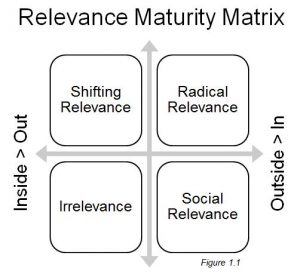
The RMM will be most effective if used as the standard to evaluate relevance across channels and the company to establish processes for continuous improvement specific to each area in relation to the quadrant it occupies on the matrix.

The least effective quadrants of the RMM are Irrelevance and Shifting Relevance. These two quadrants are based on an inside-out approach that puts the company and its products first. Most companies have departments that continue to function in these areas, if not all departments, perhaps making occasional forays into social relevance, but are unable to sustain the transition due to the lack of skills and mindset required.

An example could be a report created to speak to challenges faced by a target audience and shared with that target audience while at the same time sending out product-focused promotions to the entire database. The company’s relevance increases with the report, but this relevance quickly regresses with the continued product focus in its communications.

Social Relevance is being achieved by some companies as they work to embrace an outside-in approach, putting their focus on customers first at the least in application to customer-facing interactions in social channels. Radical Relevance is the quadrant of mastery that we should aspire to achieve. Becoming radically relevant is achieved when marketing, customer service and sales have adopted the outside-in approach with commitment that matches capabilities. It is important to note that, as in all things, mastery is not once and done. It takes continual effort to stay at the top level of any skill.

The purpose of the RMM is to help digital marketers develop a culture of customer obsession that results in the level of relevance necessary to earn and sustain a competitive advantage in the markets your company serves.

Wouldn’t it be wonderful if marketers could flip a switch and have their communications become so relevant that, when they talked, they commanded the interest that a new product launch at Apple attracts?

Becoming this relevant to your audience and building this type of credibility in your communities is what this book will help digital marketers to accomplish. Although flipping the switch may take longer than you’d like. Achieving relevance takes work, commitment and elbow grease and works best when approached as an iterative process. The reality of continuous change means that even if you reach mastery today, you’ll have to stay on your toes to keep it.

The Relevance Maturity Matrix: Four Stages of Relevance

Irrelevance:

Being irrelevant is being beside the point, immaterial, unconnected, unrelated or inapplicable to what your prospects or customers care about. Irrelevance happens when companies are self-focused; when they care more about what they want, need, or think than what their customers want, need, or think. Scenarios of irrelevance play out every day. It’s likely you are on the receiving end of many of them.

Shifting Relevance:

Relevance is a tricky construct. It’s not something you can buy and own. Relevance is a skill that must be developed and honed both over time but also in response to real-time shifts in the market. Being relevant is a new habit that must be developed and committed to. As marketers work toward helping their companies to become a more trusted and credible resource in an environment where buyers have control, it’s easy for vigilance to slip and shift back and forth from inside-out to outside-in with their messaging.

Social Relevance:

From a channel perspective, most marketers have confronted the reality that many of the new channels—if not based on social networking—certainly include an element of social. Even the corporate website now includes the capability to share content and comment on the company blog, if not elsewhere.

Social sharing options are also commonly included on email templates used for nurturing programs and demand generation. After email—most of a marketer’s distribution strategy for published digital content is based on posting on social platforms.

As marketers have made the transition to digital marketing and, buyers have become more exacting and demanding, the shift from push to pull marketing has been more successful in some cases, than others. This is obvious from the number of posts on social media that are purely intended to be communications pushed or broadcast to audiences that are thought to be reachable through social platforms. However, this approach relegates marketers to irrelevance or, at best, shifting relevance in the RMM.

Social relevance is based on conversational competency. Rather than a broadcast approach which is based on traditional “push” methods, social relevance is about context and idea expression. Conversational competence is the difference between posting a title with the link to a blog post without any additional context vs. posting a relevant reason for your audience to read the post with a link to it, for example.

Radical Relevance:

Radical relevance occurs when marketers have reached the point of customer obsession along with the skills required to apply it strategically and maintain it tactically—even as prospects and customers continuously change.

It is at this stage that digital marketing will reach its potential to drive sustainable and continuous business growth and influence the adoption of a relevance mindset across the organization. Naturally, the bar is set high. But it is within reach.

Marketing has changed more in the last two years than in the last fifty. Marketers’ number-one concern is in their ability to reach customers. The RMM is designed to enable digital marketers to turn these concerns into confidence backed by capability.

Relevance Maturity Should Be a B2B Marketing Mandate

Quality content can be found in every medium and channel. It’s no longer enough to move the needle.  B2B buyers crave meaning and connection—not just utility or value. This is a distinction that raises the bar for relevance and what marketers must achieve to create sustainable growth for their companies in the future.

Consumers and business buyers have similar opinions about vendor content – that it’s less trustworthy, biased, and not a significant influencer across the buying process. This narrowing of perspectives shouldn’t be surprising as it’s always been there. What’s changed is our ability to see how it plays out and the data and research that can now be conducted far and wide by companies, as well as the customers they serve.

Ascending the quadrants of the RMM is key to developing and executing a digital strategy that drives results and revenues. There is definitely a silver lining for companies that embrace building the skills and shifting mindsets to enable the achievement and sustainability of the highest levels of relevance: buyers want to buy, and they want to buy faster than they do today.

*Please note that this post is largely sourced from Section 1 of my book, Digital Relevance, and has been updated in the few areas where change has been evident since the book was first written. There is much more depth in the book if you’d like to learn more about the Relevance Maturity Matrix, its stages and the skills you need to achieve maturity.


Filed Under: Uncategorized

Misconceptions About B2B Buyer Personas

posted on January 20, 2026

I’m really tired of seeing people dismiss B2B buyer personas as worthless. Although, I have to admit that many of the personas I review from prospective clients are little more than recipe cards for disconnected experiences. And shame on those who are building and promoting what I’ll just call fake personas.

A half-hearted or misguided attempt to build buyer personas is not worth doing. Just forego the whole thing if you think there’s an easy button.

But here’s what bothers me even more. Year after year I read research where marketers report their biggest challenges include:

  • Knowing who to target and how to engage buyers
  • Creating compelling and engaging content
  • Creating content for specific stages of the buying process
  • Proving the ROI from content marketing

When you have 43% of B2B marketers saying their content is only hit or miss when it comes to driving value (Rising Above the Fray) and 40% say top challenges for ABM are knowing what content to use and  delivering a personalized customer experience(45%) (Not Another State of Marketing Report), there’s a disconnect between marketers and their audiences.

You’d think we’d be making progress. But the above three findings from 2021 reports indicate that’s not true for close to half of the marketers who participated in the research.

It could be—with buyer personas built to uncover true insights about attitudes, perspectives, change management, and thought processes of the people who buy and use your products and solutions.

Here’s the kicker for me > Despite the above challenges reported, two-thirds of marketers say they’re using buyer personas to inform their marketing strategies and content development. (2021 Content Management & Strategy Survey – PDF)

There are two potential conclusions I draw from the above circumstances:

  1. Marketers are fibbing about actively USING buyer personas.
  2. Their personas are not developed to be actionable. In other words, they are profile templates (fakes) masquerading as personas.

Well Built B2B Buyer Personas Provide Answers to Marketing Challenges

I’ve been building B2B buyer personas since 2007 for my clients. It’s an involved process that begins with talking to people. Lots of talking—mostly listening—goes into persona development.

And yes, your buyers and customers are primary conversations, but it goes beyond them to your sales, product, and customer teams. A selection of those who have customer-facing involvement or access should be included.

This does two things.

First, these internal conversations provide access to an extraordinary knowledge bank of insights and perspectives about your customers based on their interactions with them. What you can learn is often surprising.

Second, these conversations create buy-in and ownership across functions for the establishment of actionable buyer and customer insights that will get used in the presentation of consistent buyer and customer experiences.

Now, go talk to buyers and customers. Make sure you cover all the involved stakeholder roles so you can determine which personas are most worthwhile to spend time developing and addressing. As you have these conversations, you’ll begin solving the challenge of who to target and how to engage.

As a note of caution – this does not happen sitting around a conference table with your team and hashing out opinions over a pizza (or via zoom call with a Grub Hub-delivered lunch).

As you’re talking with buyers and customers, listen carefully and guide the conversation to learn:

  • How they discovered the problem and why they decided to try to solve it
  • Phrases and keywords they use describing the problem and the actions they took to solve it
  • Questions they needed to answer along the way
  • Obstacles that got in their way—from consensus to budget to justifying their decision
  • Areas where a lack of confidence slowed them down
  • Misperceptions they had to work to overcome—for them or for others on the buying committee
  • Who else they talked to—internally and externally
  • Where they went (channels) and how they chose to learn (webinars, reviews, blogs, videos, conferences, newsletters, influencers, analysts, etc.)
  • What they expected as an outcome—is that what they got?

Amp up your curiosity in these conversations. What you learn can instigate transformative light-bulb moments you can’t get anywhere else.

This information will help you solve your content challenges and help you create a plan for addressing buyers’ needs across their buying process. Not just give you ideas for one-off content that doesn’t build momentum or help them advance in decision making.

One Thing About ABM and Buyer Personas

I’ve also heard recently that marketers practicing ABM don’t need buyer personas, only account personas. I don’t think you want to hear my initial response to that.

But what I want you to consider is that an account persona is valuable. Yes, I agree. But without the buyer personas to roll up under it to inform your approach to each role within an account, I’m not sure where you go.

Account personas give you an understanding about the company. It’s mission, business objectives and core values to help you weave a thread of company/account relevance throughout your communications, content, and messaging. This insight helps you create experiences that bring people on the account together, rather than approaching personas in a singular thread (never advised).

So yes, account personas are a valuable, but not to the exclusion of buyer personas that help you establish relevance with each role and perspective included in the account’s buying committee.

Finally, A Persona is a Construct

The concept of a buyer persona is represented as a construct that the industry has labeled as such. I build and present mine in a way I’ve found valuable because they help my clients use them to great effect. Every bit of information included is in some way actionable. That’s the most important part of a B2B buyer persona.

Get rid of the stuff that creates noise and isn’t usable, including basic consumer demographics and things like salary, marital status, and stuff you’ll never use as a B2B marketer. Get to a level of depth in information that promotes relevance.

For example, a goal is never as simple as “grow revenues.” What does that mean to the persona you’re trying to engage? Perhaps it’s “creating efficiency in product development to get products to market faster” which results in revenue growth.

You can compile all the information discussed above in any form you want. You can call it anything you want. The most important thing is that you have the information you need to finally solve these persistent marketing challenges and create meaningful, relevant experiences for your buyers and customers.

I’ve found the answer to this to be the construct of a buyer persona.

Just don’t believe that simple one-slide templates with high-level pablum are going to get you there.

As I said before, there’s no easy button for buyer persona development. But boy are they worth it when you see engagement climb and can prove the ROI of content based on active contribution to pipeline velocity.

Filed Under: Uncategorized

Help Your B2B Buyers Do Their Own Discovery

posted on January 20, 2026

Discovery is most often considered a function performed by sales reps. But in this context, it’s more about discovery FOR the sales rep, NOT B2B buyers.

One of the problems marketing and sales have as B2B buyers’ roles shift is that they start too late in the process. I firmly believe this timing factors into why conversations with sales reps push to the back of the bus.

And this isn’t because sales reps don’t have and share information or add value. It’s the type and focus of the information that’s the issue–usually all about your product and functionality. So, they’re not considered relevant while B2B buyers are dealing with early discovery about the change process they must complete before they can buy anything.

There’s an entire change management process buyers must navigate before your potential customer is wearing their buyer hat. Until they complete all those jobs to be done, a gap still exists between buying and selling.

ABM is a Great Construct for B2B Buyer Discovery

ABM is a terrific vehicle for enabling marketers and sellers to work in parallel to help B2B buyers do their own discovery and complete their pre-buying work to enable them to buy what you’re selling.

The premise of ABM is to focus on accounts, rather than leads. What this means is focusing on the buying committees within target accounts that fit your company’s ideal customer profile (ICP).

If done well, you establish relationships that build stakeholder consensus across the buying committee. But, taken further, you can help all those stakeholders engage proactively with each other in relation to deciding how to solve the problem at hand.

First, consider the problems your future customers encounter trying to decide to whether to solve a problem, if the payoff is worth it, and how to go about it.

Diagnosing the Problem. Buyers often can see what they think is the problem in how an outcome or goal is missed when it used to be achievable. Something has changed that the current system isn’t factoring in therefore the current process is now underperforming. But, why?

Is it the process, the people, or the technology that’s underperforming? Or a combination?

  • If your buyer identifies process, then it may be a workflow issue that needs to be redesigned.
  • If your buyer identifies people, then perhaps they look for training or coaching.
  • If your buyer identifies technology, then is it an upgrade, an integration with a point solution, or perhaps using a technology used elsewhere in the business that could solve the problem.

How will they know? What work do they need to do to get to the true cause of the problem they’ve identified?

Even more so, if it’s a combination of people, process, and technology, the complexity increases – which is usually the case. It’s hard to change just one of those without impacting the others.

Enrolling the Right Stakeholders. Who are all the stakeholders to involve? This may differ depending on the type of problem diagnosed. And how will your buyer know when they’ve enrolled all the people who need to be involved in solving it? What happens if they overlook someone?

Marketers (and sellers) must realize that consensus isn’t a one-time thing. It must be reached continuously at each step, or the buying committee cannot move forward. When surprises happen, such as overlooked stakeholders showing up, stalls follow bringing that person up to speed and consensus could falter as stakeholders revisit once completed jobs.

When taking an ABM approach, focusing on all stakeholders is the point. You’re not just engaging and helping one contact advance. You must help them all make progress, as well as helping them to collaborate and compromise during that progression. Each contact in the account will come with their own perspective and responsibilities, concerns, and objectives for solving the problem. Getting alignment at each step is critical to maintaining consensus.

Evaluating Risk and Disruption. Fixing a problem means embracing change. Every company runs on a system. It’s the way companies are designed or there’d be chaos. Changing a system isn’t easy. There’s bound to be disruption and there’s the risk that things could go wrong.

Fixing a problem usually has impacts beyond the department where the problem resides. Just as the missed goals and objectives that resulted from the problem rumble beyond the department where they’ve occurred.

A business is an interconnected system. One broken thing can break others. Likewise, the fix to the problem will also have pass-along impacts.

  • What are they?
  • How will they be managed?
  • Are they acceptable?
  • What tradeoffs or compromises will need to be made among stakeholders to arrive at a solution that can maintain consensus?

Back to ABM…and Seamless Transitions

The beauty of ABM is that marketing and sales can work together to impact your B2B buyers’ discovery path when armed with the right insights, content, and plays aimed at helping with discovery. And the consistency of relevant and timely engagement will be surprising and welcome enough to get your relationship off on the right foot.

Consider that most buyers don’t make complex purchases every day. Chances are that the fix to their new problem has a bunch of unknowns to consider they didn’t deal with the last time they solved a similar problem. This leads to a lack of confidence in where to begin or even where to start to solve the problem. And a lack in confidence in themselves to move forward.

Gartner research, when looking based on size of deal, found that 50% of respondents said that surprise steps delayed buying efforts. In essence, buyers don’t know their own buying process. They need help.

Marketers and sellers often assume that buyers know what problem they’re solving and what they need to buy to fix the problem. Some of them may. Those are the folks who’ve gone through their own discovery process without your help and figured it out (or think they have)—perhaps with the help of your competitors.

Take a step back and start even earlier than you are today. Your future customers need your help to navigate their buying process. And, while you’re helping them embrace the idea of the change needed to fix the problem, you’ll be building relationships and engagement that will result in downstream revenue. And that transition will be seamless, as the next step in a well-orchestrated buying process that they are able to justify making.

As Hank Barnes asked at the end of this post, “Can we afford not to educate and guide our prospects on how to buy effectively?”

Even better, a strategic ABM transformation impacts more than marketing.

Filed Under: Uncategorized

New Post

posted on July 31, 2025

test

Filed Under: Uncategorized

Lorem ipsum

posted on April 21, 2025

Lorem ipsum dolor sit amet, consectetur adipiscing elit, sed do eiusmod tempor incididunt ut labore et dolore magna aliqua. Ut enim ad minim veniam, quis nostrud exercitation ullamco laboris nisi ut aliquip ex ea commodo consequat. Duis aute irure dolor in reprehenderit in voluptate velit esse cillum dolore eu fugiat nulla pariatur. Excepteur sint occaecat cupidatat non proident, sunt in culpa qui officia deserunt mollit anim id est laborum.

Filed Under: Uncategorized

  • 1
  • 2
  • Next Page »

Recent Posts

  • The Relevance Maturity Matrix Helps B2B Marketers Close the Gap
  • Misconceptions About B2B Buyer Personas
  • Help Your B2B Buyers Do Their Own Discovery
  • New Post
  • Lorem ipsum

Search Form

Footer

This is an example of a text widget which can be used for whatever you like.

More ...

Recent Posts

  • The Relevance Maturity Matrix Helps B2B Marketers Close the Gap
  • Misconceptions About B2B Buyer Personas
  • Help Your B2B Buyers Do Their Own Discovery
  • New Post
  • Lorem ipsum

Search Form

  • Home
  • About
  • Blog
  • Library
  • Contact
  • Home
  • About
  • Blog
  • Library
  • Contact

Copyright © 2026 · Enterprise Pro on Genesis Framework · WordPress · Log in